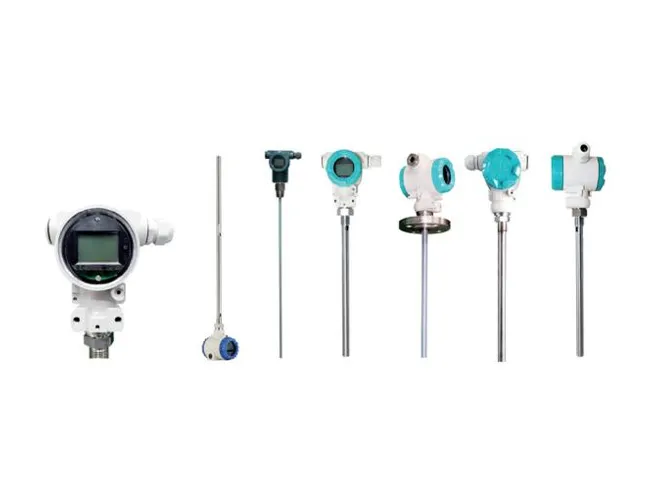
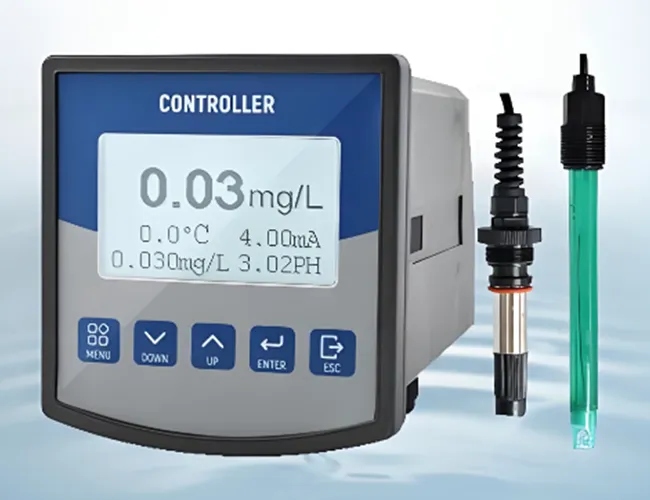
The capacitive level meter adopts the capacitance measurement principle, suitable for continuous measurement of the liquid level of various conductive and non-conductive media and powder/solid material level in industrial production processes, especially suitable for use in strong acid, strong alkali, and high-temperature (200℃) media.


Measurement range | 0. 1-30m |
Measurement accuracy | 0.1%, 0.2%, 0.5% |
Pressure resistance range | -0. 1MPa ~32MPa |
Probe temperature resistance | -40℃ ~85℃ |
Storage temperature | –55℃ ~125℃ |
Display range | -999~9999 |
Ambient temperature | -30℃~70℃ |
Relative humidity | ≤85% |
Power supply | 24V DC (18~36V) or 220VAC |
Power consumption | < 2.5W |
Weight | 1 KG |
Display | 4-digit nixie tube, 10-segment light column, 5 LED alarm indicators |
Output signal | Passive isolated 4-20mA current (powered by external power supply); Active isolated 4-20mA current (load capacity 400Ω); Isolated 4-20mA current (active or passive) + 2 channels of SPDT 3A relays; 4 channels of relays: 2 channels of SPDT 3A + 2 channels of SPST 5A. |
Communication method | HART, RS485, CAN bus communication |
Probe form | Metal probe rod and fully insulated probe rod (external PTFE protective layer, internal metal) |
Explosion-proof grade | ExibⅡBT5 |
Protection class | IP65 |
Probe Type and Application
Structure Form | Material | Conductivity of Measured Medium (s/m) | Main Application Occasions |
Cable Type | PTFE Coating | >10-3 | Used in containers, deep wells, slits, etc., for conductive media such as aqueous solutions of water, acids, alkalis, and salts. |
Rod Type | PTFE Liner | >10-3 | Used in containers, pools, etc. for conductive media such as water, acids, alkalis, and salt aqueous solutions with low viscosity and not easy to scale. |
Cylinder Type | 1Cr18Ni9Ti | <10-9 | Used in containers, pools, etc. for liquid non-conductive media such as kerosene and light oil. |
Insulated Cylinder Type | 1Cr18Ni9Tiwith PTFE | >10-9 | Used in liquid containers, pools, etc., where the sensor jacket is not corroded. |
Double Rod Type | Fully PTFE Lined | >10-3 | Used in containers, pools, etc. for conductive solutions with strong acids, strong alkali, high temperature, and strong corrosion. |
Bare Rod Type | 1Cr18Ni9Ti | <10-9 | Used for granular materials, powders, etc. in metal containers (the container is required to be made of metal materials) |
The capacitive level meter has been successfully applied on the following occasions:
Chemical plants: Detecting the level of chemical raw materials such as polyester, spandex, acids, and alkalis;
Environmental protection: Detecting sewage level;
Boiler plants: Detecting the level of media in pressure vessels;
Hydraulic machinery: Detecting lubricating oil level;
Grain sector: Detecting edible oil level;
Oil fields: Detecting finished oil level;
Paint factories: Detecting paint level;
Powder silos: Detecting materials in silos such as coal powder, cement, plastic particles, grain, feed, and flour.
Simple structure: No movable elastic parts, so the reliability is relatively high, and maintenance is minimal. In general, regular minor, medium, or major repairs are not required.
Convenient installation: The built-in structure especially shows this feature. One person with a wrench can complete the installation in a few minutes.
Convenient adjustment: The two potentiometers for zero position and range can arbitrarily perform zero migration or range compression/expansion within the effective range of level detection.
Level detection is basically not affected by changes in process conditions. Unlike buoyancy-type, differential pressure-type, and isotope-type level meters, which are related to the density of the medium during detection, changes in the density of gas-liquid media will cause additional errors in detection results.
Wide application range: Customized for the specific characteristics of the detection object, suitable for level detection under various harsh conditions.
Low operating cost, no additional impact, no vulnerable or consumable parts. Compared with isotope-type level meters, there are no additional issues such as radioactive source depreciation costs, waste source disposal costs, and radiation protection.
Lightweight: A high-pressure level meter working under 32MPa weighs less than 2 kilograms, which is a fraction of the weight of a high-pressure float level meter.
This level meter is not suitable for detecting high-viscosity media, such as molten asphalt.
Contact Huaqiang for Wholesale Water Treatment Equipment
 +86-05722755556
  Huaqiangenv@163.com
 English