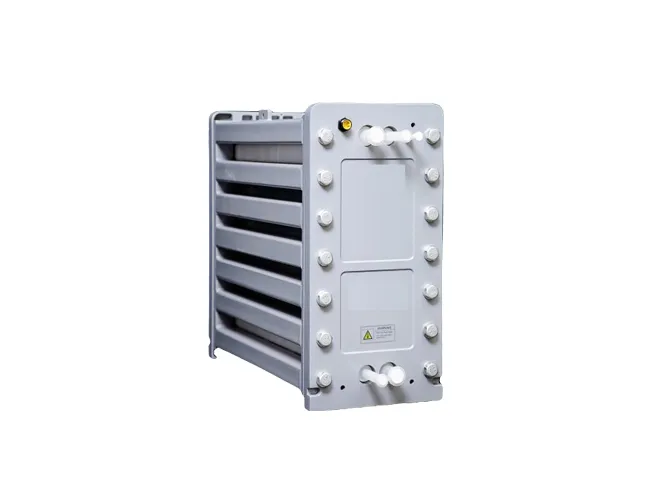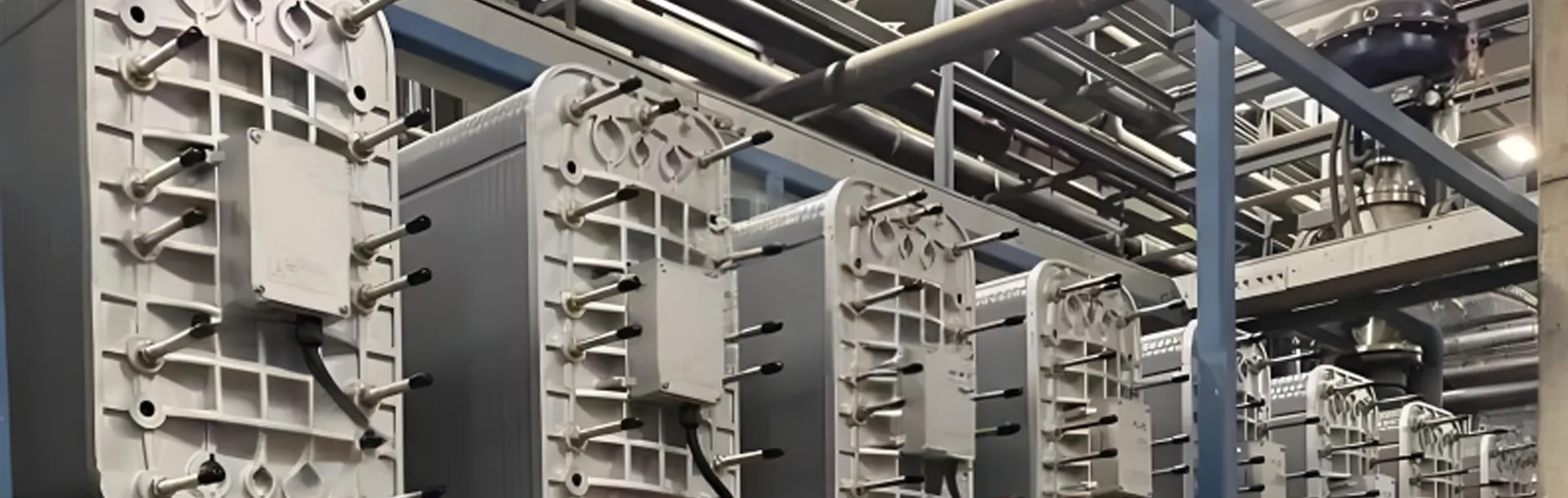
EDI (Electrodeionization) modules are advanced pure water production systems that seamlessly integrate electrodialysis and ion exchange technologies.

EDI (Electrodeionization) is a water treatment system that combines electrodialysis and ion exchange technologies. Driven by a direct current (DC) electric field, it enables the directional migration of ions and the continuous electrochemical regeneration of resins, thus allowing for the continuous production of ultrapure water without the need for acid and alkali chemicals. This system is composed of key components such as ion exchange membranes, mixed resins, electrodes, and a power supply. It is suitable for applications including semiconductor manufacturing, pharmaceutical purification, and make-up water for power plant boilers.
The core characteristics of EDI include no need for acid-alkali regeneration, stable continuous water production, high degree of automation, small floor space, and controllable operating costs, among others.
It is a pure water preparation technology that combines electrodialysis and ion exchange resins. Its core principle is to drive ion migration through a DC electric field, realize selective separation using ion exchange membranes, and simultaneously continuously regenerate the resin with H⁺ and OH⁻ generated by water electrolysis.
1. Operating environment monitoring
(1) Temperature control
The operating temperature should be maintained between 5℃-38℃. Excessively high temperatures will lead to the degradation of resin performance, while excessively low temperatures will affect ion migration efficiency. It is recommended to install a temperature monitoring device and adjust it in time when exceeding the limit.
(1)Pressure management
The inlet water pressure should be stable at 0.31-0.68 MPa, and the pressure difference should not exceed 0.24 MPa. Regularly check the pressure gauge to avoid membrane sheet rupture or seal damage caused by pressure fluctuations.
2. Inlet water quality maintenance
Key indicator monitoring
Total Anion (TEA) < 25 mg/L (calculated as calcium carbonate), hardness < 0.5 ppm, residual chlorine < 0.05 ppm, Fe/Mn/H₂S < 0.01 ppm.
Equip with professional testing instruments, regularly analyze the inlet water quality, and perform pretreatment (such as reverse osmosis or ion exchange) when abnormal.
Security filter maintenance
A security filter with ≤ 0.2 μm should be installed at the front end, and the filter element should be replaced regularly to prevent particles from clogging the module water channel.
3. Regular cleaning and disinfection
(1) Cleaning timing judgment
Cleaning must be performed immediately when the produced water volume decreases, the conductivity increases, or the pressure difference increases.
(2) Cleaning steps
Acid cleaning: Circulate 2.0% hydrochloric acid solution for 30 minutes to remove scaling (such as calcium carbonate).
Disinfection: Circulate 0.2% H₂O₂ solution for 50 minutes to kill microorganisms.
Alkaline cleaning: Circulate 1.2% NaOH + 5.0% NaCl solution for 50 minutes to remove organic pollution.
(3) Rinsing requirements
After each cleaning, rinse with RO water until neutral. After disinfection, the conductivity should be < 100 μS/cm.
4. Shutdown protection
Before the long-term shutdown, drain the water and seal it with a 0.5% formalin solution circulated for 8 minutes.
5. Maintenance records and fault troubleshooting
Establish an operating data file, record parameters such as pressure difference and resistivity. When abnormal, compare with standard values (for example, if the pressure difference of Siemens EDI exceeds 10%-15%, troubleshooting is required).
Common faults: A sudden increase in pressure difference is mostly due to colloidal pollution, hardness scaling, or organic adsorption, which requires targeted treatment.
Through the above measures, the service life of EDI modules can be effectively extended, and the produced water resistivity can be guaranteed to be ≥ 15 MΩ·cm.
Contact Huaqiang for Wholesale Water Treatment Equipment
 +86-05722755556
  Huaqiangenv@163.com
 English